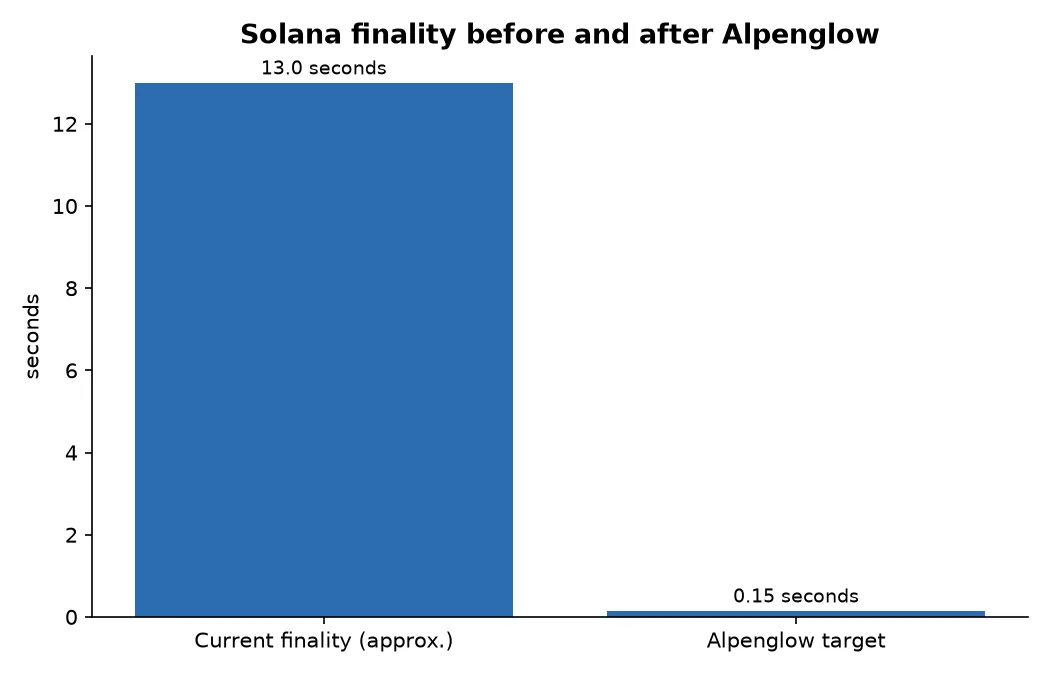
Solana is beginning a wider testnet trial of Alpenglow, an upgrade designed to make transaction finality dramatically faster. Its target is 0.15 seconds, compared with roughly 13 seconds under the current consensus design. If successful, deposits, transfers and merchant payments could become irreversible far more quickly.
Why finality matters
Finality marks the point at which a transaction is considered settled and cannot be reversed through the blockchain’s normal consensus process. It is different from raw transaction speed or network throughput.
Financial applications often wait for finality before treating a transfer as complete. Exchanges may delay crediting a deposit, while bridges may hold funds until the originating chain has reached a secure conclusion. Merchants also benefit from quicker certainty that a payment will not later disappear.
Reducing that waiting period could make blockchain-based payments feel closer to conventional real-time settlement. It could also give automated systems more time to react within the same operational window.
How the consensus mechanism changes
Solana’s existing TowerBFT system requires validators to accumulate sufficient support across 32 slots before a block becomes final. Those votes are recorded onchain, creating a sequence that participants must complete before settlement.
Alpenglow introduces Votor, a voting protocol in which validators communicate directly and can agree after one or two rounds. By removing the longer chain of onchain votes, the design aims to reach the same essential outcome much faster.
This is not simply a matter of assigning a shorter timer to the current process. The architecture changes how validators exchange evidence and coordinate their decisions, potentially reducing both the number of rounds and the communication required.
Why the broader testnet trial matters
Alpenglow has already operated for more than four months on a smaller network created specifically for development. Moving it to Solana’s established public testnet tests whether a much larger group of validator computers and supporting services can coordinate the migration together.
The public test network mirrors the main blockchain while using tokens without monetary value. That gives developers a safer environment for identifying problems, testing the transition and restarting the simulation if necessary.
A successful trial would provide stronger evidence that the upgrade can work beyond a controlled development setting. It would not, however, prove that mainnet performance will be identical.
Software readiness remains a key issue
Validators participating in the test must run Agave 4.3, the primary software client used to operate Solana. The software had previously been introduced in stages to operators representing 10% and then 25% of the SOL securing the network, allowing behavior to be examined before broader activation.
Firedancer and Frankendancer, two alternative validator programs intended to increase client diversity, have not yet joined the Alpenglow test. Their absence means the first migration trial will rely entirely on Agave rather than testing a multi-client environment.
That distinction matters because client diversity can limit the impact of a software defect. The current test will show whether the network can handle the upgrade, but it will provide less evidence about how the system behaves when different validator programs are involved.
Testnet activation is not a mainnet launch
A testnet trial is a rehearsal, not permission for users or businesses to expect immediate production service. Mainnet is the live network holding real value, so any activation would require greater confidence in validator participation, software stability and operational procedures.
Features associated with Agave 4.3 also should not automatically be interpreted as confirmation that Alpenglow is ready for mainnet. The two milestones are connected but separate.
What users and applications would notice
Existing applications are expected to continue processing transactions through familiar interfaces. Users should not need to replace wallets or alter the way they send funds. That approach is intended to make the upgrade largely invisible at the application layer.
Infrastructure providers may experience the change sooner. Exchanges could credit qualifying deposits after a shorter confirmation period, and bridges might release funds more quickly. The exact timing used by each service will depend on its own risk controls and integrations.
What comes next
The most important milestones are broad validator participation, stable network operation, successful restart testing and evidence that performance holds under realistic conditions. Client diversity will also become increasingly important as the project moves closer to production.
If the trial succeeds, Alpenglow could significantly shorten the period of uncertainty surrounding Solana transactions. Until that happens, 0.15 seconds remains a testnet target rather than a guaranteed mainnet result.